
Home Page
Poe's Life
Send an e-mail
|
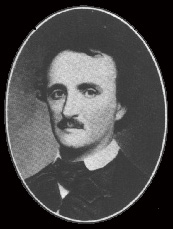
Poe's Life
Youth
Edgar Allen Poe was born January 19, 1809 in Boston to Elizabeth Arnold Poe, an English born actress, and David Poe, Jr., an actor from Baltimore, Maryland. His life was that of most children, until his mother tragically died in 1811.
The young Edgar Allen went to live with his godfather, John Allen, and his wife who were childless. From 1815 to 1820, his godfather sent him to England and Scotland to begin his classical education. When he returned to Richmond, Virginia in the United States, he studied Greek, Latin, French, Spanish and Italian. He was bright, but while at university, he gambled so excessively, that John Allen pulled him out and wouldn't let him continue.
Upon returning to Richmond from university, Edgar Allen Poe was heartbroken to find his girlfriend, Elmira Royster, engaged to another man. He left home once more, this time going to Boston where he published a pamphlet of poems entitled Tamerlane and Other Poems. Some of the poems in this collection elude to his lost Elmira.
Edgar Allen Poe had become incredibly poor. Publishing small works did not bring in the amount of money he was accustomed to living with. Because of his lack of money, he decided to join the army under a false name- Edgar A. Perry. When his foster mother died, John Allen purchased for him a release from the army, and helped to get him appointed at a United States Military Academy at West Point. Before leaving for military school, he published Al Aaraaf, Tamerlane, and Minor Poems. Edgar Allen hated military school, and successfully got himself expelled by being absent from all the drills and classes for a straight week.
Poe went to New York City briefly after this incident, and then returned to Baltimore where he wrote MS. Found in a Bottle and won for it in a contest. In 1835, he became the editor of the Southern Literary Messenger in Richmond and made a name for himself as a critical reviewer.
|
|
Adulthood
Now, in his mid-twenties, Poe began to think of marriage. He found himself strongly attracted to his 13 year old cousin, Virginia Clemm, and married her. His poem To My Mother was really written to his aunt and mother-in-law, Mrs. Maria Clemm. He was known to be a loving husband to his cousin of 13.Poe had a problem with drinking. He was fired from his job as editor because of this habit, and while he did not get drunk often, when he did it was in a public place which tended to make a scene. Contrary to gossip, he was not a drug addict, but instead had a brain lesion. His fevered dreams and intense nightmares came from this illness.
Poe went on to write for and edit many papers and magazines. He was published often, and this is the point where he began to achieve his fame.
|
|
Final Years
During 1845, a famous, yet older poet, Frances Sargent Locke Osgood, heartlessly persued Edgar. His young wife, Virginia, didn't object to this relationship, but "Fanny's" indiscreet writing about her literary love caused some intense scandals.
His wife, Virginia, died in January of 1847. The next year, Poe left for Providence, Rhode Island, to persue Sarah Ellen Whitman, yet another poet. They were engaged briefly, and he had many close platonic relationships with a great multitude of women, of whom he seemed to favor poets.
In 1849, Poe returned to Richmond where he found his lost love Elmira once more. She was now the widowed Mrs. Shelton, and he finally became engaged to her. Yet, even after getting the love of his life, he had yet another incredibly close friendship with a poet by the name of Susan Archer Talley.
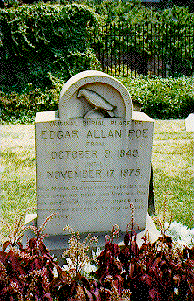
October 7, 1849, after toasting a lady's birthday in Baltimore, he began to drink heavily. His heart was weak and couldn't take the stress of the excess alcohol, and he died that day. He is buried, we believe, in West Minister Presbyterian church yard in Baltimore, although there is some question about his place of rest.
Two days later these words appeared in the New York Tribune:
"Edgar Allan Poe is dead. He died in Baltimore the day before yesterday. This announcement will startle many,but few will be grieved by it. The poet was known, personally or by reputation, in all this country; he had readers in England, and in several of the states of Continental Europe; but he had few or no friends; and the regrets for his death will be suggested principally by the consideration that in him literary art has lost one of its most brilliant but erratic stars."
This was written by Rufus Wilmot Griswold, a literary rival who is said to be a secret enemy of Poe.
|
|
|
|
|
|
|
|
|
|
|
